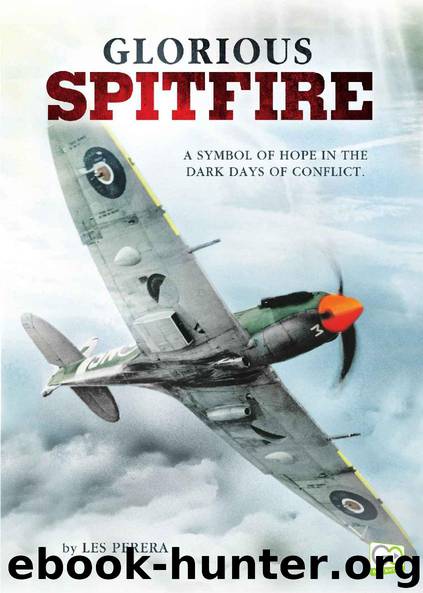
Glorious Spitfire: A Symbol of Hope in the Dark Days of Conflict by Les Perera & Go Entertain
Author:Les Perera & Go Entertain [Perera, Les]
Language: eng
Format: epub
Publisher: Go Entertain
Published: 2015-10-21T22:00:00+00:00
The design saw only limited use.
RECORD BREAKER
THE SUPERMARINE SPITFIRE was unique in being the only British fighter aircraft to be in continuous production before, during, and after the Second World War. With a total of 20,334 Spitfires, and a further 2,408 navalised versions known as the Seafire, it was also the only Allied fighter to be manufactured continuously throughout the wartime period. Originally designed as a day interceptor fighter, it was “... the best conventional defensive fighter of the war", according to the RAF fighter ace J E ‘Johnnie’ Johnson. First entering into service with No 19 Squadron of the RAF on 4 August 1938, the Spitfire flew its last offensive sortie as a fighter when four Mark XVIIIs from No 60 Squadron, led by Group Captain Wilfred Duncan Smith, took part in a strike against a ground target near Kota Tinggi, Malaya, on 1 January 1951. A photo-reconnaissance version, a Spitfire PR Mark 19, made the last ever operational flight to be undertaken by any RAF Spitfire when it was flown over Malaya on 1 April 1954. Even at that late date, the Spitfire was destined to continue in service for her country, when three Mark 19s were modified for meteorological work and flown by civilian pilots with the Temperature and Humidity Monitoring (THUM) Flight, based at Hooton Park in Cheshire, and Woodvale, Lancashire. These aircraft were eventually retired in 1957 and flown to RAF Biggin Hill, where they formed the nucleus of the Historic Aircraft Flight, precursor to the Battle of Britain Memorial Flight.
Establishing actual numbers of victories in aerial warfare depends on whether or not any successes claimed by a pilot have been witnessed, and verified, by others. One of those whose prowess in air combat was undisputed became Britain’s, and the Allies’, top-scoring fighter ace of World War II. James Edgar ‘Johnnie’ Johnson was credited with a verified score of 34 enemy aircraft shot down, as well as seven shared victories, three shared ‘probables’, ten enemy damaged, three shared damaged, and one enemy aircraft destroyed on the ground. Johnson’s tally was, amazingly, achieved even though he did not take part in the Battle of Britain; this was due to his being hospitalised for surgery to a pre-existing shoulder injury that had hindered his ability to fly a fighter in anything other than ideal circumstances, let alone in air combat. His score was made even more creditable because all of his victories, except for one of the shared victories against a Messerschmitt Me-110, were gained exclusively against single-engined enemy fighters; his aircraft in all of these successes was the Spitfire. Since joining an operational squadron, Johnson flew the Spitfire exclusively throughout the war, his mounts later bearing the trademark fuselage code JE-J, even though his official squadron code was different, such personalisation being the ‘perk’ of a wing leader.
One of Johnson’s personal aircraft became, almost certainly, the most successful individual RAF aircraft in combat, Spitfire Mark IX, EN398. He first set eyes on this particular aircraft when
Download
This site does not store any files on its server. We only index and link to content provided by other sites. Please contact the content providers to delete copyright contents if any and email us, we'll remove relevant links or contents immediately.
| Africa | Americas |
| Arctic & Antarctica | Asia |
| Australia & Oceania | Europe |
| Middle East | Russia |
| United States | World |
| Ancient Civilizations | Military |
| Historical Study & Educational Resources |
Room 212 by Kate Stewart(5119)
The Crown by Robert Lacey(4814)
Endurance: Shackleton's Incredible Voyage by Alfred Lansing(4780)
The Iron Duke by The Iron Duke(4354)
The Rape of Nanking by Iris Chang(4211)
Joan of Arc by Mary Gordon(4109)
Killing England by Bill O'Reilly(4001)
Say Nothing by Patrick Radden Keefe(3983)
I'll Give You the Sun by Jandy Nelson(3446)
Shadow of Night by Deborah Harkness(3367)
Hitler's Monsters by Eric Kurlander(3341)
Mary, Queen of Scots, and the Murder of Lord Darnley by Alison Weir(3210)
Blood and Sand by Alex Von Tunzelmann(3203)
Eleanor & Park by Rainbow Rowell(3171)
Darkest Hour by Anthony McCarten(3129)
Margaret Thatcher: The Autobiography by Thatcher Margaret(3081)
Book of Life by Deborah Harkness(2938)
Red Famine: Stalin's War on Ukraine by Anne Applebaum(2932)
The One Memory of Flora Banks by Emily Barr(2863)
